

One community is protected.
The other is left behind.
Fire safety isn’t only about flames, smoke, and alarms. It’s about inequality. It’s about who is protected and who is not.
Across the world, poverty, exclusion, and systemic neglect determine who lives with fire risk and who can escape it.
In some neighbourhoods, homes are built to resist fire, streets are wide enough for fire trucks, and insurance helps people recover.
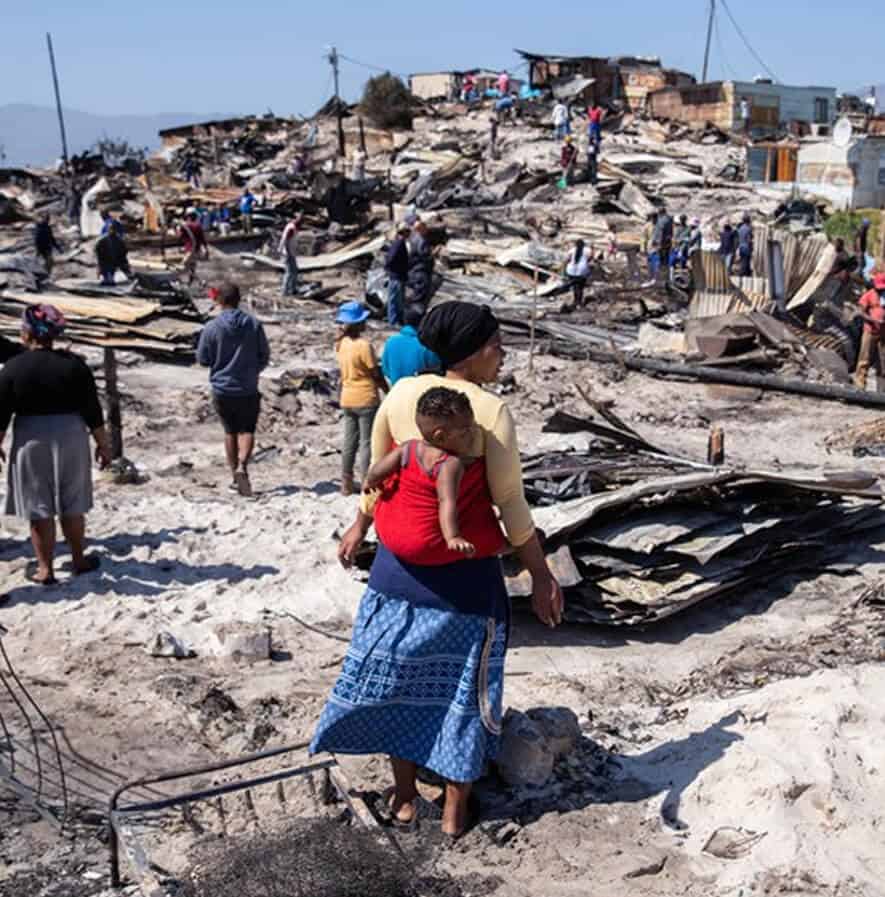
In others, fires start from informal electrical connections and spread between homes built just centimetres apart. Formal response systems may exist, but they are rarely fit for purpose. Fire stations are too far away, equipment isn’t designed for such dense environments, and water supplies are unreliable. The system was never built to protect the people most at risk, so they have to rely on themselves.
These risks are not random. They are the result of systems that have long failed the people most affected: from historic and present land laws that pushed people to the margins, to modern policies that overlook marginalized communities. The outcome is predictable and profoundly unjust.
Fire exposes inequality in its rawest form: who is injured, who dies, who is rescued, who can rebuild, and who is forgotten. It is a human-made crisis, preventable, yet sustained by the very systems that created it.
Ignored by agendas, paid for in lives.
Fire safety is rarely integrated into the major global systems that shape risk such as disaster risk reduction, urban development, humanitarian action, and climate change adaptation. Each of these fields touches fire in some way, yet none take full ownership of it.
Kindling sits at these intersections advocating for integration of fire safety, and creating the research, learning, and practices tools necessary to make it happen.

We work to bring attention to and ultimately to address the following systemic gaps:
In disaster risk reduction, fire is overshadowed by floods, storms, and earthquakes. Disasters that strike less often but affect everyone. Settlement fires, by contrast, are frequent, localized, and devastating for the poorest. They represent what experts call extensive risk: small in scale, but relentless in impact.
In urban development, fire is treated as a technical issue and a matter of compliance, not justice. It is rarely seen as a question of safety, equity, or resilience.
In humanitarian action, fires are viewed as unfortunate but inevitable. Ones that are temporary emergencies rather than systemic failures.
And in climate change agendas, fire is framed almost entirely through wildland and forest fires, leaving out the dense urban and informal areas where billions of people live.
The result is a global blind spot. Entire communities live and build in conditions where a single spark can erase hundreds of homes in minutes. These are not accidents, they are the predictable outcomes of systems that never accounted for fire in the first place.
“It’s time we start looking at urban fire in relation to climate change and fire risk reduction in urban environments as a form of climate adaptation”
- Danielle Antonellis
Kindling Founder & Executive Director
Behind every statistic is a story
Every fire is more than an event, it’s a breaking point. In a few minutes, families lose everything they’ve built: homes, memories, and the sense of safety that holds a community together. What remains is grief, trauma, and the long, painful work of starting again.
180,000
people die from fires each year
Millions
of people are injured by fire annually
Fire safety proves adaptation is possible.
Fire will always be part of human life. But every time a community reduces risk, rebuilds stronger, or prevents a fire from spreading, it shows what adaptation can look like in practice.
Fire safety demonstrates that progress is achievable even in the most constrained environments. It brings together design, science, and local knowledge to protect lives and strengthen systems. The same foundations needed for climate adaptation and urban resilience.
Each improvement, however small, matters: a safer pathway, a better-built roof, a community that organizes to respond together. These actions ripple outward, improving health, stability, and trust. They show that adaptation isn’t abstract or far away, it’s already happening.
Fire safety proves that change is possible. And when the world begins to take fire seriously, it doesn’t just make communities safer, it makes them stronger.


“We’ve educated one another, not only has kindling brought insight into the community, but we have also opened up each other’s minds.”
- Awodwa Ntlali
Communications Officer
